You’ve planned the perfect itinerary, packed the right gear, and bought the standard travel insurance policy your credit card company recommended. But what happens when a simple slip on a wet trail hours from a major city shatters your femur? You assume your insurance will fly you home.
You would be wrong.
Standard travel insurance is designed to stabilize you, not bring you back. If the local clinic is deemed “adequate” by a remote claims adjuster, that is where you will stay, navigating a foreign healthcare system alone. This is exactly why experienced travelers are shifting their focus toward travel evacuation membership plans. Let’s understand the real experience and why this single distinction can mean the difference between a minor disruption and a $100,000 nightmare.
What Are Travel Evacuation Membership Plans?
Travel evacuation membership plans are specialized transport agreements, not traditional health insurance. If you are hospitalized over 150 miles from home, these memberships guarantee and fully fund your air medical transport back to your home hospital, bypassing the limitations of standard insurance.
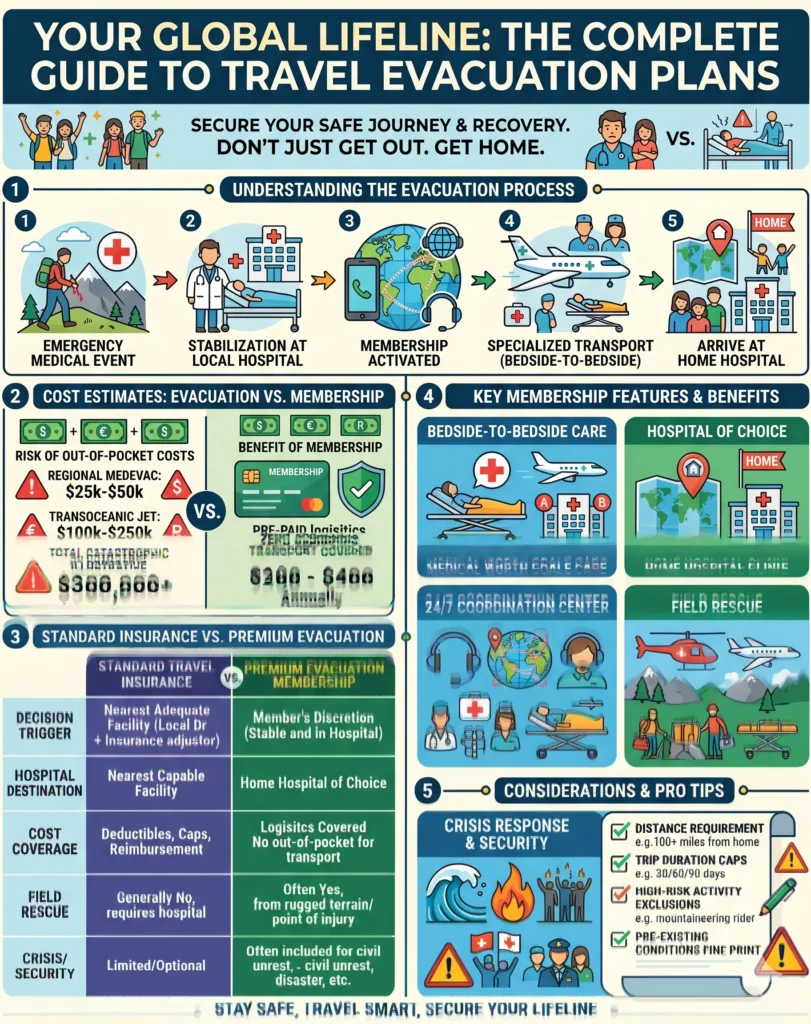
Standard travel insurance operates under a strict “nearest adequate facility” clause. If you suffer a severe injury, they will only pay for an emergency medical evacuation to the closest hospital capable of treating you. If you want to recover near your family with your own trusted doctors, standard policies won’t pay for the flight. A medevac membership exists solely to solve this problem. You pay an annual or short-term fee, and if disaster strikes, companies like Medjet or Global Guardian coordinate and pay for the specialized jets required to get you home, with no deductibles or claims forms.
Hospital of Choice Transfer vs. “Nearest Adequate”
A hospital of choice transfer is a premium benefit that allows a hospitalized traveler to dictate exactly which medical facility in their home country they are flown to for recovery, overriding any insurance company’s preference for local, cheaper care.
Here is why this matters. Imagine you are exploring remote regions. Your standard policy might evacuate you from a village to the capital city. The hospital there might be “adequate” to perform surgery, but it may not be where you want a complex operation. Memberships that include a “Member’s Discretion” clause mean that as long as you are stable enough to fly, you decide when to leave. You aren’t arguing with a medical director over the definition of adequate care; you are simply making the call to go home.
The Reality of Field Rescue Services
Field rescue services involve dispatching a specialized extraction team—often utilizing helicopters and former military personnel—to retrieve an injured traveler directly from the point of illness or injury, rather than waiting for them to reach a hospital first.
Most travel insurance policies require you to be formally admitted to a hospital before any transportation benefits kick in. But what if you are halfway up a mountain or on a remote island? This becomes important when you look at adventure travel. Companies like Global Rescue specialize in this exact scenario. If you cannot get to a road, they come to you.
Destination Realities: Where Memberships Save Lives
To truly grasp the value of these plans, we have to look at the terrain. Let’s connect this to your trip planning with two regions where a membership is practically mandatory.
The Karakoram Highway, Pakistan
- Local Name: شاہراہ قراقرم (Shahrah-e-Karakoram)
- English Description: The highest paved international road in the world, connecting Northern Pakistan to China.
- Urdu Translation: دنیا کی بلند ترین پختہ بین الاقوامی سڑک (Dunya ki buland tareen pukhta bain-ul-aqwami sarak)
- Pronunciation: Shah-rah-e-Karakoram
If you are following one of our extensive Pakistan travel guides, you know the remote beauty of Hunza and Gilgit is unmatched. However, if you suffer severe altitude sickness or a traumatic injury here, the local clinics are basic. A standard policy will transport you to Islamabad. A high-tier membership will ensure an air ambulance service picks you up from Islamabad and flies you all the way back to New York or London.
The Swiss Alps, Switzerland
- Local Name: Schweizer Alpen
- English Description: The rugged, high-altitude alpine region covering the southern half of Switzerland, famous for off-piste skiing and mountaineering.
- Pronunciation: Shvy-tzer Al-pen
Switzerland has world-class healthcare, so standard insurance will never fly you home from here; they will simply treat you in Zurich or Geneva. But if you require weeks of physical therapy and multiple surgeries after a skiing accident, staying in a Swiss hospital is incredibly isolating and expensive. An evacuation membership ensures you get the initial emergency care locally, and then transports you via a medically equipped jet back to your hometown surgeon.
Air Ambulance Services: Understanding the Logistics
Air ambulance services utilize private, customized aircraft outfitted as flying intensive care units, staffed by critical care nurses and paramedics, to transport severely ill patients across international borders safely.
These flights are staggeringly expensive. A standard commercial medical escort might cost $10,000, but a private, trans-oceanic medical jet easily ranges from $50,000 to $250,000 out of pocket. Standard travel credit cards (even premium ones like the Chase Sapphire Reserve) do not cover these costs if the local hospital is deemed adequate. A dedicated membership shields you from this catastrophic financial risk. You pay your membership fee (usually between $100 for a short trip to $400 for an annual plan), and the transport costs are covered entirely.
How to Choose Your Plan for 2026
Not all memberships are created equal. When reviewing your packing checklists and securing your visas, add a membership evaluation to your pre-trip workflow. Match the provider to your specific travel style:
- For Absolute Control: Look at Medjet. They are the gold standard for “Member’s Discretion.” If you are hospitalized and want to go home, they arrange it. They are best for general leisure, business travelers, and expats.
- For Remote Adventures: Look at Global Rescue. If your destination-specific pages include the Himalayas, the Amazon, or African safaris, their field extraction capabilities and security advisories are unmatched.
- For Corporate / High-Net-Worth: Global Guardian operates a massive fleet of jets and focuses heavily on seamless, zero-out-of-pocket, bedside-to-bedside transport.
Always check the fine print regarding distance limits (most require you to be at least 150 miles from home) and trip duration caps (annual plans usually cover trips up to 30, 60, or 90 consecutive days).
People Also Ask:
Yes, but only to the nearest adequate facility. Standard travel insurance will pay to move you to a local hospital capable of treating your condition, but it will rarely pay to fly you all the way back to your home country if local care is deemed sufficient.
Travel insurance covers medical bills, lost luggage, and trip cancellations. Medjet is not insurance; it is a transport membership. Medjet focuses strictly on moving you from a foreign hospital back to your home hospital of choice, regardless of medical necessity.
An international medical evacuation flight typically costs between $30,000 and $250,000, depending on the distance, the type of aircraft required, and the specialized medical team needed on board.
No. Global Rescue covers the logistical costs of rescuing you from the field and transporting you to a hospital. You still need traditional health or travel insurance to pay the actual medical bills for doctors, surgeries, and medications.
The modern duty of care for yourself and your family requires looking past the glossy brochures of standard trip protection. Knowing that a specialized team is ready to pull you out of danger and bring you to your own doctors is the ultimate travel hack. Before you book your next flight, evaluate your current insurance limits, consider your destination’s infrastructure, and secure a travel evacuation membership. It is the one investment you hope to never use, but will forever be grateful you have.