Have you ever stared at photos of the dazzling lights of Times Square, the rolling hills of San Francisco, or the historic, cobblestone streets of Boston, only to sigh and close the tab because your bank account politely said, “Absolutely not”? You are certainly not alone. The dream of exploring major American metropolises often crashes hard into the reality of soaring hotel rates, pricey restaurant menus, and staggering ticket prices.
I clearly remember my first time visiting New York City. I had just graduated from college, and my wallet was painfully thin. On my very first afternoon, hungry and completely exhausted from walking around Midtown Manhattan, I sat down at a bright, flashy diner near the theater district. A simple turkey sandwich and a soda cost me nearly $30. I almost choked on my drink! Right then and there, I realized I had to drastically change my approach if I wanted to survive the week without maxing out my credit card. That single, overly expensive sandwich became a defining moment for my future adventures. I quickly learned that the real magic of a destination isn’t found in its overpriced tourist traps, but in the vibrant, everyday rhythms of local life.
Consequently, I am here to tell you that you do not have to go broke to visit the most expensive cities in the USA. With a bit of strategic planning, a willingness to step outside your comfort zone, and some proven budget travel tips, you can significantly cut down your travel expenses. By shifting your perspective, you can uncover affordable accommodation, enjoy mouth-watering cheap eats, and save money on travel without sacrificing an ounce of fun. Let’s dive into a comprehensive, detailed guide on how to experience the very best of urban America on a strict budget.
1. Timing is Everything: Embrace the Off-Season
The most fundamental rule of saving money on any trip begins long before you even pack your bags. When you choose to travel is just as important as where you choose to go. Naturally, major cities are packed with tourists during the summer months and around major holidays like Thanksgiving, Christmas, and the Fourth of July. During these peak periods, airlines and hotels predictably hike up their prices simply because they know people will pay them.
However, if you can be flexible with your dates, you can unlock massive savings. This is where the beauty of off-season travel comes into play. If the dead of winter sounds unappealing to you, aim for the “shoulder season”—the sweet spot right between peak and off-peak times. For instance, visiting a city like Chicago in late September or Boston in early May means you still get to enjoy pleasant weather, but you avoid the overwhelming summer crowds. Moreover, flights and hotels are noticeably cheaper.
Additionally, consider shifting your travel days. Flying on a Tuesday or Wednesday is almost always less expensive than flying on a Friday or Sunday. You can easily compare these daily fluctuations by utilizing flexible date search tools on platforms like Google Flights or Skyscanner. A tiny adjustment to your travel itinerary can leave hundreds of extra dollars in your pocket right from the start.
2. Sleep Smart: Finding Affordable Accommodation
Let’s face it: lodging is usually the largest chunk of any vacation budget. Staying in a fancy downtown hotel might sound incredibly convenient, but it will quickly drain your funds. Fortunately, there are plenty of creative ways to secure affordable accommodation that are just as comfortable.
First, look beyond traditional hotels. While they aren’t quite as prevalent in the United States as they are in Europe or Southeast Asia, hostels are fantastic, budget-friendly options. Platforms like Hostelworld list modern, clean, and safe hostels in nearly every major U.S. city, from Los Angeles to Miami. Many even offer private rooms if you aren’t keen on sharing a dormitory, giving you the social atmosphere of a hostel with the privacy of a hotel.
If you prefer a more private, home-like experience, consider house-sitting. Websites like TrustedHousesitters connect travelers with locals who need someone to watch their pets and home while they are away. In exchange for watering plants and cuddling a cat, you get a free place to stay! Alternatively, for the truly adventurous and social traveler, Couchsurfing allows you to stay with welcoming locals for free, providing an authentic cultural exchange that money simply cannot buy.
If you are renting a short-term apartment or booking a standard room, follow these steps to ensure you are getting the absolute best deal:
1.Study the transit map:
Before even looking at hotel prices, pull up a map of the city’s public transit system, such as the MTA in New York or the CTA in Chicago. Identify the main train lines that run into the city center.
2.Search one neighborhood away:
Downtown cores are always the priciest. Expand your search to residential neighborhoods that sit directly on a reliable train or bus line. A short 15-minute subway ride can often cut your nightly room price in half.
3.Filter for valuable amenities:
When browsing booking sites, use the filter tools to show places that offer free breakfast, complimentary Wi-Fi, or, most importantly, access to a kitchen or microwave.
4.Compare multiple platforms:
Do not rely on just one website. Check hotel aggregators, direct hotel websites, and vacation rental platforms to cross-reference prices and uncover hidden discounts.
5.Book early with free cancellation:
Lock in a reasonable rate as soon as you can, provided the booking offers free cancellation. Continue monitoring prices as your trip approaches, and easily swap if a significantly better deal appears.
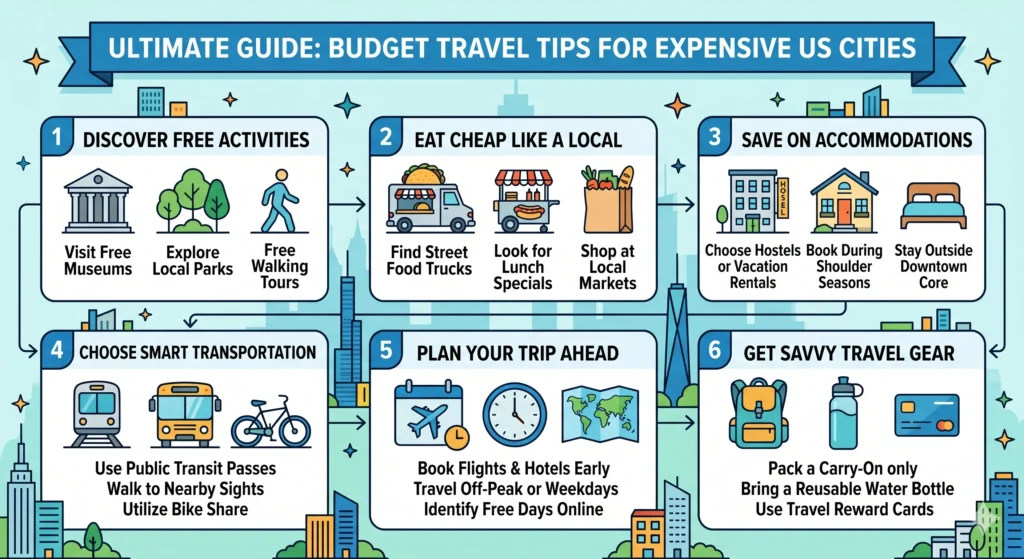
3. Ditch the Rental Car and Ride Like a Local
One of the biggest mistakes visitors make when heading to expensive cities in the USA is assuming they need to rent a car to get around. In reality, a car in a dense metropolis is an expensive, stressful liability. Between daily rental fees, exorbitant overnight hotel parking costs, unexpected toll roads, and the constant stress of navigating unfamiliar, congested one-way streets, a vehicle will quickly eat away at your travel budget.
Instead, your best friend on this journey is public transportation. Cities like Washington D.C., Boston, Seattle, and San Francisco have extensive, reliable transit networks. Buying a multi-day unlimited transit pass will almost always be cheaper than taking just two or three rideshare trips in an Uber or Lyft.
Furthermore, do not underestimate the power of simply walking. Walking is completely free, excellent for your physical health, and the absolute best way to stumble upon hidden gems, charming neighborhood cafes, and beautiful street art that you would otherwise miss from the back seat of a taxi.
Traveler’s Insight: If your itinerary requires you to travel between close cities—like New York to Philadelphia or Boston—skip the short domestic flights. Opting for a budget bus company likeMegabusor taking a scenic train ride viaAmtrakcan drastically lower your travel expenses while providing a relaxing journey without the massive hassle of airport security lines.
4. Eat Like a Local: Navigating the Culinary Scene
Food is frequently the second largest expense on a trip, but it is also one of the easiest areas to trim down. You do not have to eat generic fast food for every meal to stick to your budget, nor do you have to sacrifice tasting the authentic local flavors of your destination. The secret to finding incredible cheap eats is simply avoiding the glowing neon signs of major tourist epicenters.
For instance, if you are visiting a famous landmark, walk at least three to four blocks away before looking for a restaurant. Establishments located right next to major attractions pay massive commercial rents and inevitably pass those operating costs directly onto the tourists.
Moreover, lean heavily into the diverse neighborhoods that make American cities so culturally rich and special. Head to places like Chinatown, Little Italy, or local Latino neighborhoods for authentic, inexpensive dining. During a trip to San Francisco, I purposely skipped the overpriced seafood restaurants at Fisherman’s Wharf. Instead, I wandered into the Mission District and found a tiny, unassuming taqueria. For just $8, I ate the most incredible, massive burrito of my life.
Another brilliant dining strategy is to make lunch your biggest meal of the day. Many high-end, acclaimed restaurants offer spectacular lunch specials that feature the exact same high-quality dishes as their dinner menus, but at a fraction of the cost. Finally, do not forget to visit local supermarkets or farmers’ markets. Buying fresh fruit, crusty bread, and local cheese for an afternoon picnic in a city park is not only incredibly budget-friendly, but it also provides a delightful, relaxing experience away from the crowds.
| Expense Category | Tourist Trap Approach | Budget-Savvy Approach | Estimated Daily Savings |
| Dining | Sit-down restaurants near major attractions | Local food trucks, grocery stores, and ethnic enclaves | $40 – $70 |
| Getting Around | Ride-shares (Uber/Lyft) and daily car rentals | Subways, buses, bicycles, and walking | $30 – $50 |
| Attractions | Buying individual tickets at the door | Utilizing free days, walking tours, and city passes | $20 – $60 |
| Hydration | Buying bottled water throughout the day | Carrying a reusable water bottle to refill | $10 – $15 |
5. Master the Art of Sightseeing on a Shoestring
You might instinctively assume that seeing the best sights in the most expensive cities in the USA will cost a small fortune, but there is an incredible wealth of free activities just waiting to be discovered. The trick is simply doing a little bit of online homework before you arrive.
Many world-class museums offer free admission days, “pay-what-you-wish” hours, or discounted evening rates. For example, the magnificent museums of the Smithsonian Institution in Washington D.C. are completely free every single day of the year. Similarly, you can explore the stunning architecture of public libraries, wander through massive urban green spaces like New York’s Central Park or Chicago’s Millennium Park, or window-shop through historic, cobblestone districts without ever opening your wallet.
If your heart is set on visiting several paid attractions—such as observation decks, world-renowned aquariums, or guided boat tours—look deeply into multi-attraction passes. Services like CityPASS bundle the most popular attractions together at a steeply discounted rate. As long as you actually plan to visit the included sights, these passes are highly economical and allow you to skip the ticketing lines.
Allow me to share a quick story: During a trip to San Francisco, my friends and I were heavily pressured by a street vendor into buying a $50 ticket for a narrated, crowded bay cruise. Instead, we decided to rent bicycles for less than half the price. We spent the entire afternoon pedaling across the iconic Golden Gate Bridge, feeling the salty ocean breeze on our faces and taking photos at our own pace. Not only did we save a massive chunk of our budget, but the experience was infinitely more exhilarating and personal than sitting on a noisy, crowded boat.
6. Pack Smart to Avoid Hidden Fees
Lastly, the way you pack your suitcase before leaving home can actually have a surprising, direct impact on your wallet. Airlines in the United States are notorious for charging exorbitant fees for checked luggage, sometimes upwards of $35 to $50 each way. By committing to traveling with just a carry-on bag and a personal item like a backpack, you can instantly save anywhere from $70 to $100 per round-trip flight.
Furthermore, packing light forces you to be highly strategic. Bring versatile, comfortable clothing in neutral colors that you can easily mix and match. You will be walking a lot in these urban environments, so a reliable, broken-in pair of comfortable walking shoes is absolutely non-negotiable.
Additionally, always remember to pack a high-quality reusable water bottle. Bottled water at tourist attractions, theme parks, or airports can cost an outrageous $5 a piece. By simply refilling your bottle at public water fountains or asking cafes for tap water, you stay perfectly hydrated and keep those crucial dollars where they belong: in your travel fund.
7. Leverage Technology and Travel Rewards
In today’s fast-paced digital age, your smartphone is arguably your most powerful tool to save money on travel. Before you even leave your living room, make sure you are utilizing the right applications and financial tools to guide your decisions.
Firstly, if you foresee yourself traveling even a couple of times a year, seriously consider looking into travel reward credit cards. Many of these cards offer substantial sign-up bonuses that can be redeemed for free flights, hotel stays, or statement credits. Websites like The Points Guy offer excellent, beginner-friendly advice on how to effectively navigate the sometimes confusing world of travel points. By simply routing your everyday living expenses—like groceries and gas—through a rewards card and paying the balance off immediately, you can essentially earn free travel over time without changing your spending habits.
Additionally, while you are physically on the road, applications can be absolute lifesavers. Use Yelp or TripAdvisor to filter restaurants by price (specifically looking for the single dollar sign) to find highly-rated, inexpensive meals nearby. If you do end up needing a car for a short period, apps like SpotHero allow you to reserve secure parking spaces in major cities for a mere fraction of the cost you would pay if you just pulled up to the gate.
Moreover, if you are a solo traveler looking for the ultimate budget-friendly adventure, consider participating in a work exchange. Global organizations like Worldpackers or WWOOF connect you with eager hosts in major cities or nearby rural areas. In exchange for a few hours of honest work a day—whether that is helping at a busy hostel front desk, managing a social media account, or gardening—you receive free lodging and often free meals. It is a brilliant, immersive way to extend your travel itinerary indefinitely without worrying about draining your savings account.
Conclusion: Adventure Awaits
Ultimately, exploring the most expensive cities in the USA doesn’t require winning the lottery or dipping into a bottomless trust fund. By simply adopting a flexible mindset, taking full advantage of public transportation, seeking out creative and affordable accommodation, and savoring the authentic, local cheap eats, you transform yourself from a passive tourist into an active, financially savvy traveler.
These budget travel tips are not at all about depriving yourself of joy or comfort; rather, they are about spending your hard-earned money intentionally. When you successfully cut back on the mundane, forgettable expenses—like overpriced turkey sandwiches, expensive checked bags, and unnecessary cab rides—you create the financial freedom to splurge on the incredible experiences that truly matter to you. So start drafting your ultimate travel itinerary, pack your carry-on bag tightly, and get ready to see the big city completely on your own terms!
Frequently Asked Questions (FAQs) for Budget City Travel
Q: What is the “shoulder season,” and why is it best for budget travel? A: The shoulder season is the sweet spot right between peak tourist season (like the middle of summer) and the true off-season (like the dead of winter). Traveling during these months—such as May or September—means you will find significantly lower prices on flights and hotels while still enjoying pleasant weather and much smaller crowds.
Q: How can I avoid overpaying for food near major tourist attractions? A: The golden rule is to walk at least three to four blocks away from major landmarks before choosing a restaurant. Establishments right next to tourist epicenters pay massive commercial rent and pass those costs directly to you. Instead, head to distinct cultural neighborhoods, take advantage of high-end lunch specials, or pick up fresh ingredients at local markets.
Q: Should I rent a car when visiting dense cities like New York, Chicago, or San Francisco? A: Generally, no. Renting a car in a major metropolis introduces daily rental fees, exorbitant overnight parking costs, and the massive stress of navigating traffic. Instead, buy a multi-day pass for the city’s public transportation network, rent a bicycle, or simply rely on walking to get around cheaply and efficiently.
Q: What are the safest and most affordable alternatives to expensive downtown hotels? A: Look into modern hostels on platforms like Hostelworld, which frequently offer private rooms if you do not want to sleep in a dorm. You can also explore house-sitting through TrustedHousesitters or book a room in a residential neighborhood that sits on a reliable subway line, keeping you just a short commute away from the expensive downtown core.
Q: How do I experience world-class museums and attractions without going broke? A: Always do your research before arriving. Many top-tier museums offer specific free admission days, discounted evening hours, or “pay-what-you-wish” entry. If you plan to visit multiple major paid attractions, look into bundled ticket services like CityPASS to secure steeply discounted bulk rates.